

How to Choose the Right Acrylic Sheet Thickness
Acrylic sheet thickness should be selected from the finished product backward – not from a single “3 mm, 5 mm or 10 mm” chart. The right thickness depends on product size, unsupported span, support method, permanent load, service temperature, fabrication process, optical requirements and, for pressure-loaded applications, engineering calculations.
This guide explains the main factors that affect acrylic thickness selection and gives practical starting points for displays, thermoformed parts, vertical panels, shelves, ceiling panels, colored acrylic, fire-retardant acrylic, pools and aquariums.
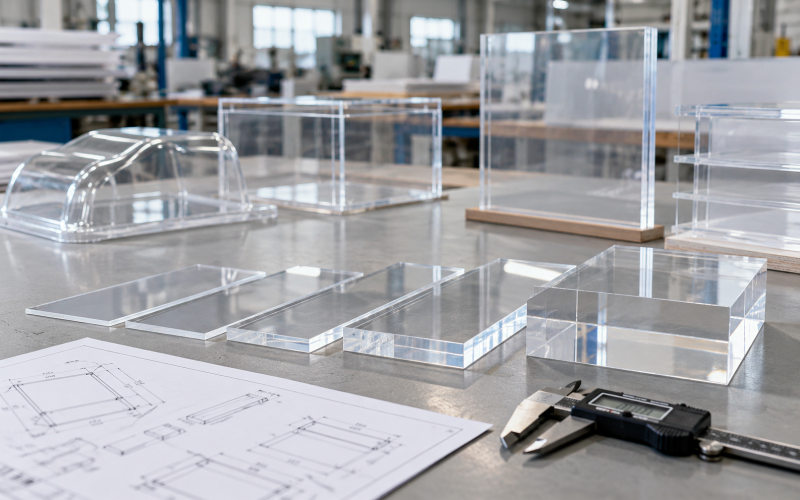
Quick Answer
There is no universal acrylic thickness that works for every product. For small thermoformed parts, 2-3 mm is often a practical starting range, while larger or deeper formed parts may require 5-10 mm because the sheet becomes thinner after stretching. Tall vertical panels, shelves, ceiling panels, fire-retardant acrylic, colored illuminated panels and pool windows each require a different thickness-selection method.
The most reliable approach is to define the finished product first, then check unsupported span, height and width, edge support, load, temperature, fabrication, light transmission, water pressure and the minimum wall thickness required after forming.
1. Start With the Finished Product – Not the Sheet
The most common thickness-selection mistake is to start with a sheet catalogue and ask, “Is 5 mm strong enough?” The better question is: what is the finished part expected to do?
A 5 mm sheet may be more than enough for a small display cover, but too flexible for a tall freestanding panel. A 3 mm sheet may work very well for a shallow vacuum-formed part, but not for a deep draw where the wall becomes much thinner after forming. A thick sheet used horizontally may still sag if the unsupported span is too large.
Before choosing thickness, define:
- overall length, width and height;
- whether the panel is vertical, horizontal, formed or pressure-loaded;
- the unsupported opening or free span;
- which edges are supported, framed or slotted;
- expected loads, including self-weight, products, wind, impact or water pressure;
- service temperature and nearby heat sources;
- fabrication processes such as cutting, drilling, bending, bonding or thermoforming;
- optical requirements such as transparency, color, haze, privacy or light transmission.
A few PMMA properties explain why thickness matters
Typical general-purpose PMMA data provide a useful starting point. Exact values vary by cast or extruded grade and by special formulation, so grade-specific datasheets should always take priority.[1]
| Property | Typical reference | Why it matters for thickness |
|---|---|---|
| Density | ~1.19 g/cm3 | About 1.19-1.20 kg per m2 for every 1 mm of thickness. |
| Short-term elastic modulus | ~3,300 MPa | Much less rigid than glass or metal, so span and support strongly affect deflection. |
| Tensile strength at 23 C | ~72-80 MPa | Useful as a material property, but not a safe allowable design stress for long-term loaded parts. |
| HDT at 1.8 MPa | ~95 C extruded; ~105 C cast | Typical standard PMMA reference values; special grades differ. |
| Linear thermal expansion | ~0.07 mm/m.C | Allow movement in frames, slots and fastener holes. |
| Permanent service temperature | ~70-80 C | A practical long-term reference for standard grades; confirm grade-specific data. |
Weight rises directly with thickness
Using a density of 1.19 g/cm3, sheet mass per square metre is approximately:
Weight (kg/m2) ~= 1.19 x thickness (mm)
| Thickness | Approx. mass per m2 |
|---|---|
| 2 mm | 2.38 kg/m2 |
| 3 mm | 3.57 kg/m2 |
| 5 mm | 5.95 kg/m2 |
| 8 mm | 9.52 kg/m2 |
| 10 mm | 11.9 kg/m2 |
| 15 mm | 17.85 kg/m2 |
| 20 mm | 23.8 kg/m2 |
| 50 mm | 59.5 kg/m2 |
| 100 mm | 119 kg/m2 |
| 200 mm | 238 kg/m2 |
| 400 mm | 476 kg/m2 |
This becomes important for large panels, ceiling systems, moving covers, hinges, support frames and handling.
2. Height, Width and Support Can Matter More Than Thickness
Acrylic is a plastic material with a density of about 1.2. It is lightweight and easy to fabricate, but it is also relatively flexible compared with glass or metal. A tall sheet standing vertically can bow under its own weight even when the material is nowhere near its breaking strength.
For vertical partitions, machine windows, guards and signs, always consider:
- panel height and width;
- free span between supports;
- whether both sides are held in slots;
- whether there is a perimeter frame;
- whether intermediate brackets or ribs can be added.
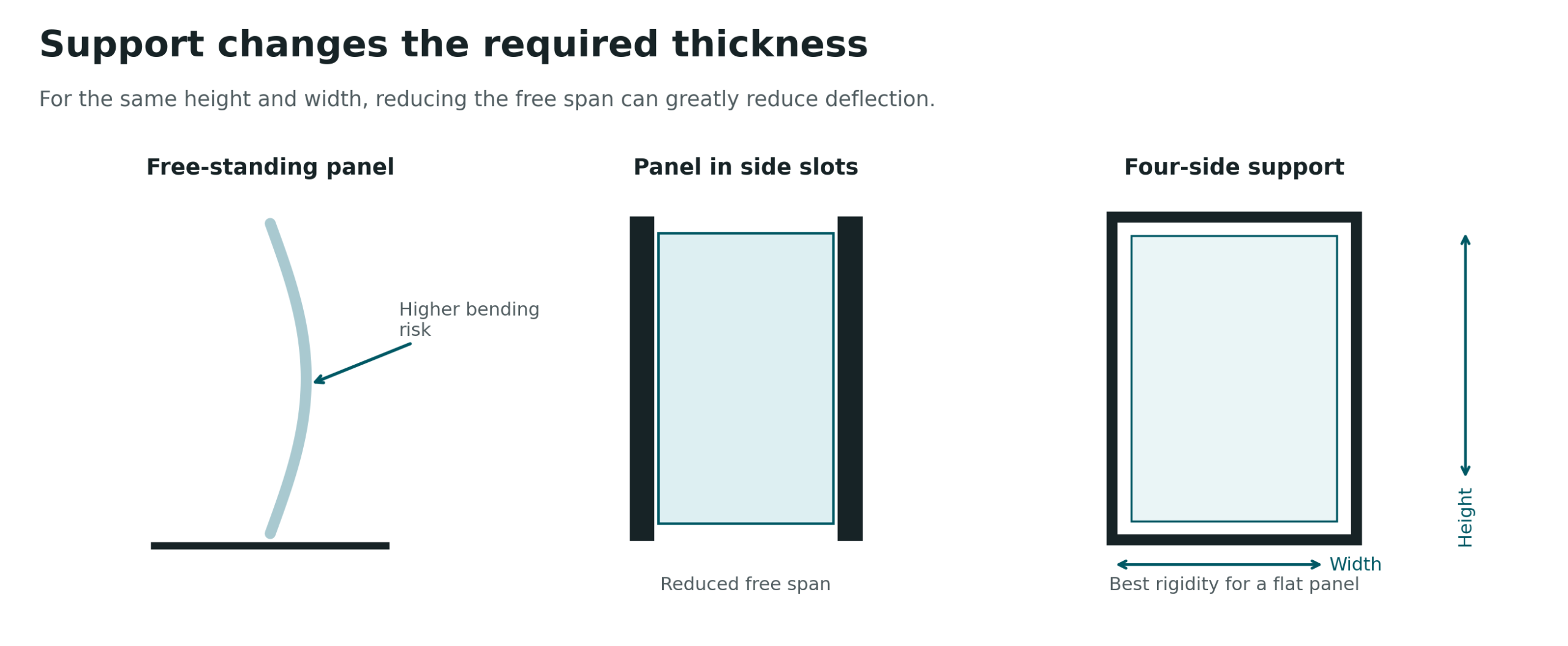
Practical rule: if a panel is tall, wide or visibly flexible, first ask whether the unsupported span can be reduced with side slots, brackets, ribs or a perimeter frame. Better support is often more efficient than simply adding thickness.
3. Thermoforming Thickness Must Allow for Stretching and Thinning
For vacuum forming or pressure forming, the starting sheet thickness should be selected from the finished part backward. Acrylic becomes thinner as it stretches over the mould, and the minimum wall thickness is often found in the deepest or most highly stretched area.
For many small to medium thermoformed acrylic products, around 2-3 mm is a common starting range. If the product is larger, deeper or has a high draw ratio, the starting sheet may need to increase to 5-10 mm.

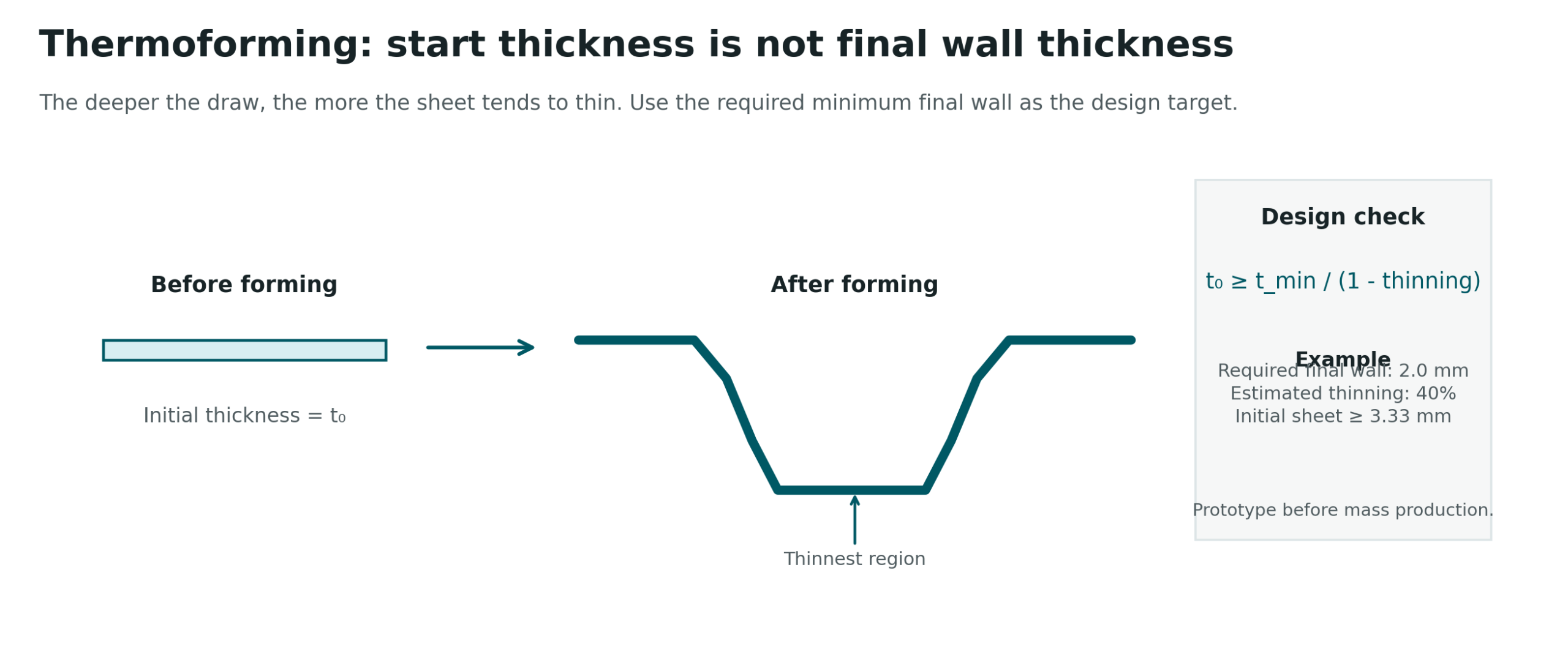
A simple way to work backward from the final wall
If process trials or forming simulation indicate a thinning fraction r, a useful screening calculation is:
Initial thickness t0 >= required minimum final wall tmin / (1 – r)
Example: if the finished part must retain at least 2.0 mm at its thinnest area and the process is expected to thin that area by 40%, the calculated starting thickness is:
2.0 / 0.60 = 3.33 mm
The next available sheet thickness should then be checked by a real forming trial. Mould geometry, draw depth, corners, prestretch, snap-back and process temperature can all change the final material distribution.[2]
4. Horizontal Panels Need a Span-and-Load Check
Acrylic used horizontally behaves very differently from a small vertical sign. Shelves, covers, tabletops, ceiling panels and flat canopies must carry their own weight across a free span, and they may also carry products, lighting fixtures or other loads.
The unsupported span is one of the strongest drivers of sag. In simplified plate behaviour, deflection increases rapidly as span increases and decreases strongly as thickness increases. This is why a large horizontal panel can deform even when the material itself is not close to failure.
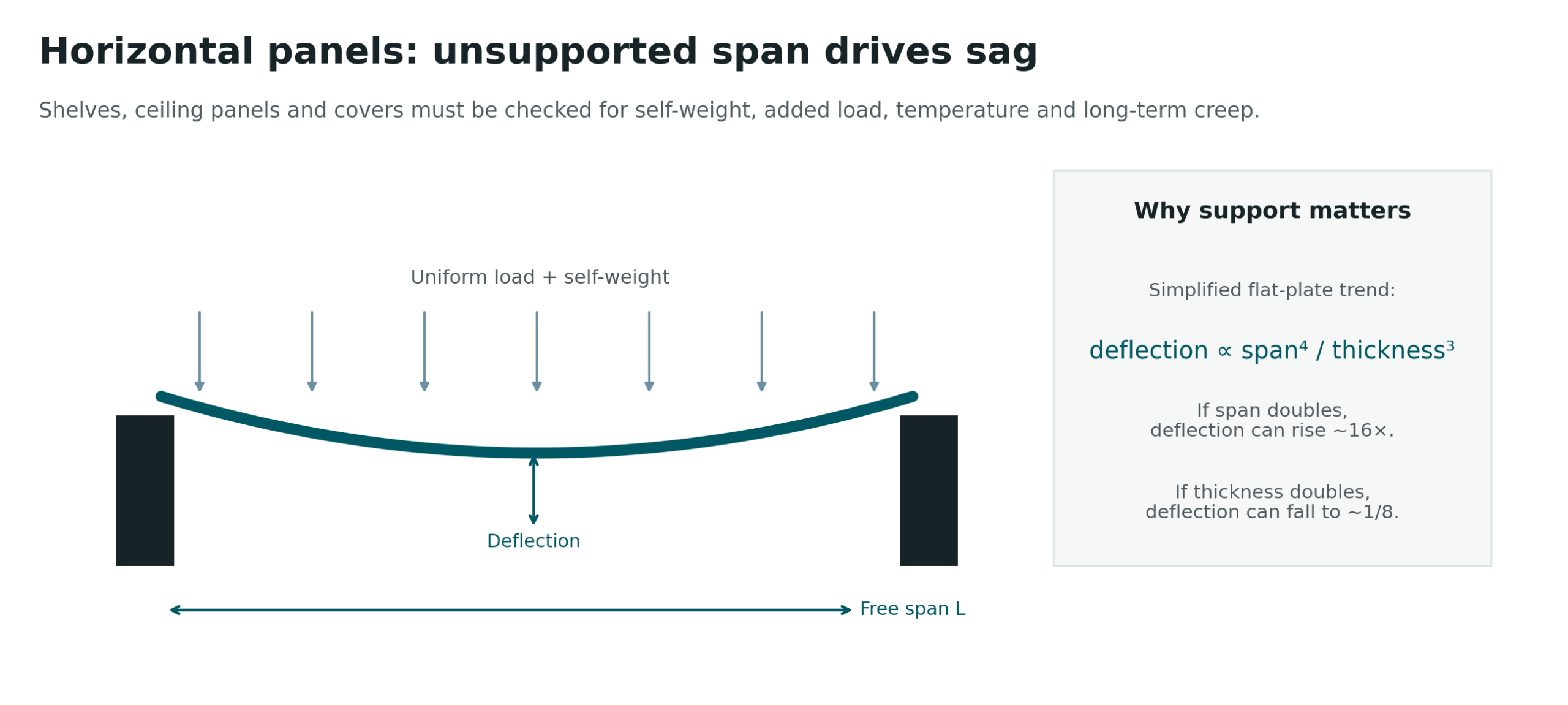
Ceiling panels deserve extra caution
For suspended ceilings or overhead decorative panels, do not select thickness from appearance alone. Check the open span between rails, self-weight, temperature from lighting, fixtures attached to the panel and the consequences of long-term sag.
Reducing the bay size with secondary supports is often more effective than simply increasing sheet thickness. For overhead applications, deformation is not only a cosmetic problem – it can affect fit, safety and long-term service life.
5. Fire-Retardant Acrylic Needs a Separate Thickness Review
Do not assume that a fire-retardant acrylic sheet can use the same thickness as standard clear acrylic just because both are PMMA-based. Flame-retardant formulations can have different thermal and mechanical behaviour.
Typical standard PMMA reference data show heat-deflection temperatures around 95-107 C at 1.8 MPa depending on cast or extruded grade.[1] For the MASON fire-retardant grade used in KINGSCOPE projects, a practical project reference is around 70 C. Because the material becomes easier to deform as temperature rises, large spans or panels near heat sources may require a shorter free span, more support or a thicker gauge.
Important: UL94 flame rating and structural stiffness are different requirements. A panel can meet a flame-retardancy requirement and still need a separate structural review.[7]
6. Colored Acrylic: Thickness Is Also an Optical Decision
For colored, opal and translucent acrylic, thickness affects more than strength. It can change light transmission, brightness, color depth, diffusion and lamp-hiding performance.
An ACRYLITE technical note provides a useful example for translucent white acrylic. In one white grade, light transmission falls from 54% at 3 mm to 43% at 4.5 mm and 35% at 6 mm; another grade falls from 31% to 23% to 18% across the same thicknesses.[4]
| Example grade | 3 mm | 4.5 mm | 6 mm |
|---|---|---|---|
| WT031 example | 54% | 43% | 35% |
| WT030 example | 31% | 23% | 18% |
For light boxes, signs and illuminated displays, ask for light transmission at the actual thickness, haze or diffusion, transmitted-light color, LED spacing and the required brightness. A thicker colored sheet may be mechanically better but optically too dark for the project.
See our Colored Acrylic Sheets range for available color and project options.
7. Pool and Aquarium Panels Must Be Designed From Water Pressure
Pool windows and large aquarium panels should never be selected from a simple depth-to-thickness chart. Water pressure increases linearly with depth, while the total force on the panel grows with both water depth and panel size.
For water density rho ~= 1000 kg/m3 and gravity g = 9.81 m/s2:
Bottom pressure: p = rho g h
Resultant horizontal force per metre of panel width: F = 1/2 rho g h2
| Water depth | Bottom pressure | Resultant force per 1 m panel width |
|---|---|---|
| 0.5 m | 4.9 kPa | 1.23 kN/m |
| 1.0 m | 9.8 kPa | 4.91 kN/m |
| 1.5 m | 14.7 kPa | 11.04 kN/m |
| 2.0 m | 19.6 kPa | 19.62 kN/m |
| 2.5 m | 24.5 kPa | 30.66 kN/m |
| 3.0 m | 29.4 kPa | 44.15 kN/m |
At 2 m water depth, bottom pressure is about 19.6 kPa and the resultant load is about 19.6 kN per metre of panel width before safety factors. At 3 m depth, the resultant load rises to about 44.1 kN per metre of width.
The final thickness must also consider:
- panel width and height;
- whether one or both sides are in contact with water;
- edge embedment and support condition;
- allowable deflection;
- long-term creep;
- temperature;
- safety factors;
- bonding and installation method;
- engineering calculation or FEA for large projects.
KINGSCOPE supplies selected thick cast acrylic sheets up to 400 mm for pool, aquarium and engineering projects.[6] This is a manufacturing capability, not a universal thickness recommendation; large pressure-loaded panels should be reviewed project by project.
8. Fabrication Can Change the Thickness You Need
Machining and drilling
Holes, slots and sharp internal corners create local stress concentrations. Heavily loaded parts may need a thicker panel, larger corner radii or more material around holes.
Bonding and assembly
A box or enclosure may become much stiffer after bonding, while a large unbonded cover remains flexible. Joint design can be as important as the sheet gauge.
Bending
Thicker acrylic needs more heat and usually a larger bend radius. If a part must be thermoformed or line-bent, process feasibility should be reviewed before thickness is fixed.
Polishing
Very thin edges are easier to distort or overheat during finishing. Thick precision parts may also be selected partly for machining allowance and final edge quality.
Fasteners and frames
Acrylic expands more than glass or metal. Slots, oversized holes, gaskets or flexible seals may be needed so a restrained sheet does not build up thermal stress.
Outdoor use and dark colors
Sunlight can raise panel temperature, especially with dark colors. Higher temperature lowers stiffness and increases thermal movement, so support and clearance become more important.
For project processing options, see KINGSCOPE Acrylic Fabrication.[8]
9. A Practical Acrylic Thickness-Selection Workflow
| Step | Check | What to define |
|---|---|---|
| 1 | Define the finished product | Overall dimensions, orientation, appearance and application. |
| 2 | Measure the unsupported span | Use the open area between supports, not the full outside sheet size. |
| 3 | Define the load | Self-weight, products on shelves, wind, water pressure, impact, maintenance load or equipment load. |
| 4 | Define the support condition | Two edges, four edges, side slots, point fasteners, bonded assembly or free-standing. |
| 5 | Check the environment | Service temperature, nearby lights or heat, outdoor exposure, dark colors and long-term continuous load. |
| 6 | Check the fabrication process | Cutting, drilling, bending, thermoforming, bonding, polishing and machining allowance. |
| 7 | Check optical requirements | Light transmission, haze, privacy, color depth, anti-glare or anti-reflective performance. |
| 8 | Apply grade-specific data | Standard cast, extruded, colored, fire-retardant, antistatic, hard-coated and thick-cast sheets are not identical. |
| 9 | Prototype or calculate | Use forming trials for complex formed parts; use structural calculation or FEA for pressure-loaded, overhead or safety-critical panels. |
Application starting points – use with caution
| Application | Practical starting point | What decides the final thickness |
|---|---|---|
| Small / shallow thermoformed parts | 2-3 mm | Minimum final wall, draw ratio, mould geometry and forming process. |
| Medium formed covers / housings | 3-5 mm | Part size, depth, local thinning and required rigidity. |
| Large / deep thermoformed parts | 5-10 mm | High draw, minimum wall, prestretch or snap-back, and stiffness after forming. |
| Tall free-standing or partition panel | No universal gauge | Height, width, supported edges, slots or frame, and allowable bow. |
| Shelf / ceiling / horizontal cover | Calculate by span and load | Open span, support, self-weight, added load, temperature and creep. |
| Fire-retardant acrylic panel | Grade-specific review | HDT and stiffness of the FR grade, temperature, span and support. |
| Colored / illuminated panel | Optical data first | Transmission or haze at actual thickness, color and LED system. |
| Pool / aquarium panel | Engineering design | Water depth, contact area, span, edge embedment, creep, safety factors and FEA. |
10. Information to Send Before Asking for a Thickness Recommendation
- Final product or application and whether the panel is vertical, horizontal, formed or pressure-loaded.
- Overall length x width x height and the actual unsupported opening or span.
- Which edges are supported and the width or depth of channels, frames or slots.
- Expected load: product weight, wind, water depth, impact, fixtures or other external force.
- Service temperature, nearby heat sources, indoor or outdoor use and expected temperature range.
- Material type: cast, extruded, colored, fire-retardant, antistatic, hard-coated, AG/AR or thick cast.
- Fabrication: cutting, holes, slots, CNC, thermoforming, bending, bonding and polishing.
- Optical requirement: clear, colored, translucent or opaque, target transmission, haze or privacy.
- Drawing, sketch, photo, sample and required quantity.
Frequently Asked Questions
Is 3 mm acrylic strong enough?
Sometimes. It is common for small covers, light display parts and many shallow thermoformed products, but it may be too flexible for tall, wide or horizontally spanning panels. Size, span and support matter more than thickness alone.
Is 5 mm acrylic much stiffer than 3 mm?
Yes. Bending stiffness rises strongly with thickness. In a simplified plate comparison, stiffness is related to thickness cubed, so a relatively small increase in thickness can make a large difference in deflection.
What thickness should I use for an acrylic shelf?
Do not choose shelf thickness from width alone. Use the free span between supports, shelf depth, centre or distributed load, self-weight, service temperature and acceptable sag. Two-side support is different from four-side support.
What thickness is best for vacuum forming?
Many small and medium parts start around 2-3 mm, while larger or deeper parts may need 5-10 mm. The required minimum final wall thickness and expected thinning should determine the starting sheet.
Can I use the same thickness for fire-retardant acrylic as regular acrylic?
Do not assume so. Review the actual fire-retardant grade’s HDT, stiffness and service temperature, then check span and support. Flame rating and structural behaviour are separate requirements.
How do I choose thickness for a pool window?
Use a structural calculation based on water depth, panel dimensions, edge embedment or support, material properties, allowable deflection, long-term creep and safety factors. Large pool and aquarium panels should be reviewed by a qualified engineer.
Need Help Choosing the Right Acrylic Thickness?
Send us your product size, unsupported span, support method, material type, application, expected load and fabrication requirements. Our team can help review the suitable acrylic sheet and processing direction before quotation.
Request a Quote | Explore Acrylic Sheets
Technical Notes and References
- Roehm / PLEXIGLAS – PLEXIGLAS GS and XT Technical Information 211-1: density, modulus, thermal expansion, service temperature and HDT. Source
- ACRYLITE – Thermoforming technical guidance: wall thickness, draw ratio, mould design and material distribution. Source
- ACRYLITE – Uniform-load, centre-load, shelving and glazing guidance demonstrating the importance of orientation, free span and support. Source
- ACRYLITE – Light transmission guidance for white and colored acrylic, including thickness effects for translucent white grades. Source
- KINGSCOPE / MASON – Acrylic Sheets product family and specification overview.
- KINGSCOPE / MASON – Thick cast acrylic panels up to 400 mm for engineering, pool and aquarium projects.
- KINGSCOPE / MASON – Fire-Retardant Acrylic Sheet, UL94 V-0 project information.
- KINGSCOPE – Custom acrylic fabrication and cut-to-size project support.
Engineering note: numerical examples in this guide are for technical screening and education. They are not structural approvals. Safety-critical glazing, overhead panels, pressure-loaded parts, pool windows and large aquarium panels require project-specific engineering review.
